
Carlsberg Group reaffirms climate commitment with updated ESG programme ‘Brewing Tomorrow’
Carlsberg Group launches Brewing Tomorrow, its updated Environmental, Social and Governance (ESG) programme. It reconfirms Carlsberg’s commitment to reduce the impact on the planet and people by tackling the issues that matter most to our business, and to society.
Brewing Tomorrow is launched following the Group’s second largest acquisition ever and reflects its new portfolio and geographic presence. The aim being to continue Carlsberg’s commitment to deliver long-term resilience and sustainable growth.
A strengthened programme
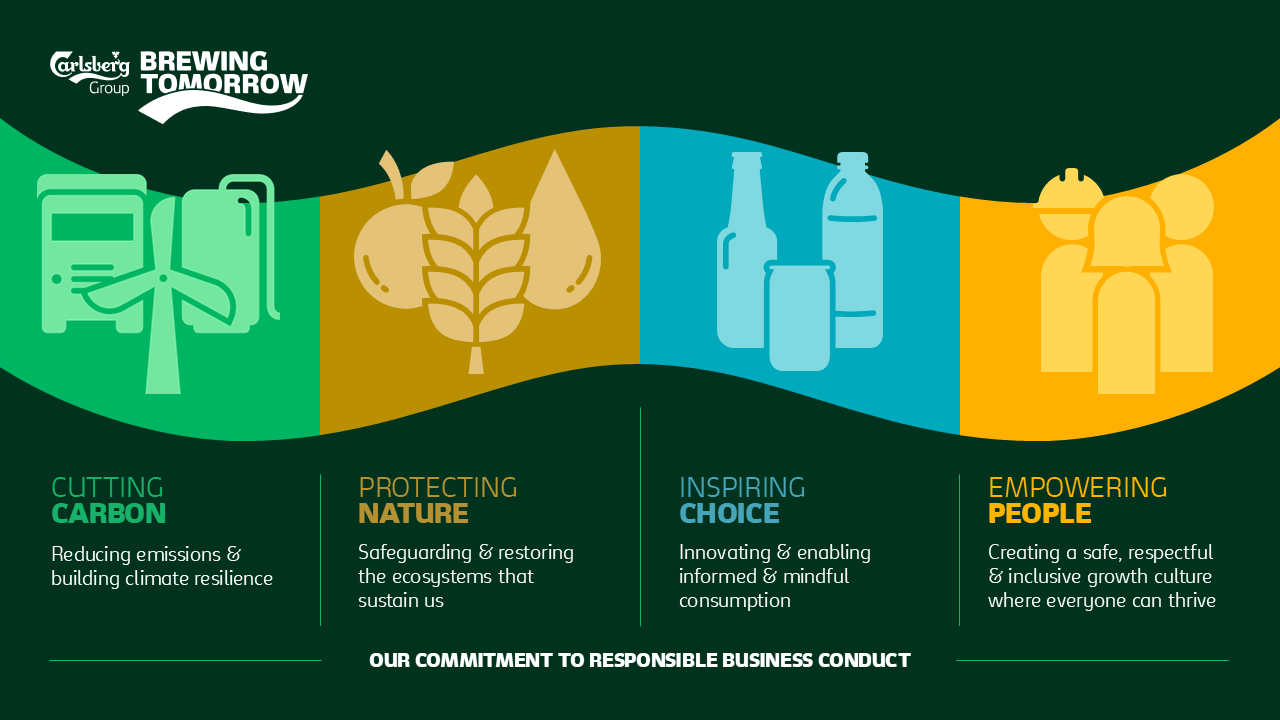
With Brewing Tomorrow, Carlsberg is strengthening its commitment to sustainability. Built around four pillars - Cutting Carbon, Protecting Nature, Empowering People and Inspiring Choice – the new structure provides a simpler and more actionable roadmap. Brewing Tomorrow raises Carlsberg’s climate ambition by introducing updated absolute Scope 3 reduction targets in line with requirements of the Science Based Targets initiative (SBTi), the leading global standard for corporate emissions reductions targets. Brewing Tomorrow also deepens commitments to regenerative agriculture and recycled materials and adds new sugar‑reduction goals in line with the growth of the soft drinks portfolio. The programme also introduces a new target focused on employees’ experience of inclusion, while maintaining its target on women in senior leadership position, supporting Carlsberg’s aim to build a truly thriving and inclusive workplace.
With the acquisition of Britvic in 2025, Carlsberg has added nearly 1 million tonnes of CO2e emissions to their value chain – a 16% increase – and produces a more complex beverage portfolio, consisting of 30% soft drinks. To credibly adapt to these significant changes, while meeting the elevated ambition of reducing absolute carbon emissions, the target year for Brewing Tomorrow has moved by two years, to 2032. Carlsberg maintains its commitment to a net zero value chain by 2040. More details on how we drive climate action can be found in our first-ever consolidated Climate Transition Plan, available here: Climate Transition Plan.
A roadmap for real action
Brewing Tomorrow is embedded in the company’s strategy, governed through clear accountability across functions and markets. "Carlsberg is on an exciting journey. We are evolving as a company, with a broader portfolio and a wider geographic presence. Brewing Tomorrow is our sustainability road map of action, built on strong performance in the recent years. The aim is clear: to drive impact and ensure Carlsberg is a future-ready business,” says Jacob Aarup-Andersen, Carlsberg Group CEO.
Carlsberg has a strong track record of progress, from being among the first companies in the world to commit to SBTi targets in 2017, to eliminating coal from production sites in 2022. Just last year, the Group delivered an 8% reduction in absolute value chain emissions compared with 2024, reached 51% recycled content in bottles and cans, replenished 32% of water consumed at sites in priority high-risk areas (up from 16% in 2024), had 31% of brews sold be no- or low-alcohol (up from 30% in 2024), and saw 34% of senior leadership roles held by women (up from 30% in 2024).
“With Brewing Tomorrow, we are building on our learnings from the past, while updating our focus for the future. The programme is embedded in our business: how we run our operations, how we engage across our value chain, how we develop our people, and how we create more choice across our expanding portfolio. It builds on decades of reducing our impacts, while supporting our business growth. I am proud of the journey we are on and cannot wait to bring it to life with colleagues and partners across the world,” says Simon Boas Hoffmeyer, VP, Group Sustainability & ESG, Carlsberg Group.
Brewing Tomorrow is built upon:
Cutting Carbon: Carlsberg will continue reducing emissions and building climate resilience. It is significantly raising its climate ambition by moving from relative to absolute carbon reduction targets across Scope 1, 2, and 3 emissions. This pillar lays out the plan for circular packaging and a net zero future.
Protecting Nature: Carlsberg is committed to protecting and restoring the ecosystems that sustain its business by focusing on regeneration and water stewardship. The targets include advancing regenerative agriculture, improving water efficiency and replenishing water resources.
Inspiring Choice: Carlsberg will continue to innovate to enable informed and mindful consumption by shaping consumer behaviour and expanding its portfolio. The company’s targets focus on consumer engagement, transparent product information, and diverse product offerings across both no- and low-alcohol and no- and low-sugar beverages.
Empowering People: Carlsberg is empowering its people by building a safe, respectful & inclusive growth culture where everyone can thrive. The targets focus on further ingraining a zero accidents culture, advancing women in senior leadership and ensuring that everyone feels included.
Performance highlights from 2025
Cutting Carbon:
Achieved a 12% reduction in absolute emissions at our production facilities and an 8% reduction in absolute near-term value chain emissions since 2024.
- Our new biomass energy facility in Laos is supplies over 80% of Vientiane Brewery’s steam requirements using locally sourced biomass. This replaces fossil fuels and reduces annual CO2e emissions by 84% – or approximately 15 kt CO2e.
- We sourced 90% of our electricity from renewables, with 19% coming from new renewable assets (operational and contracted), a major leap from 6% in 2024. We signed 3 new power purchase agreements (PPAs) in Norway, Finland and Sweden in 2025.
Achieved 51% recycled content in our bottles and cans, surpassing our 2030 target of 50% five years ahead of schedule.
Protecting Nature:
We procured 27,600 tonnes of barley grown with some regenerative principles – totalling 2% of raw materials and doubling the amount from 2024. Of this, 7,000 tonnes were grown with leading regenerative principles, our strictest category. We continue to expand regenerative farming pilots in France, UK, Finland and Denmark.
- Brasseries Kronenbourg, our French business, signed an agreement with grains suppliers, ensuring that from 2026, 1664 Blonde beer will be made with 100% traceable barley malt and incorporate regenerative agricultural practices.
32% of the water consumed at our production sites in high-risk areas has now been replenished, up 16% from 2024.
- We replenished 1.46 million m3 of water in areas near our high-risk sites in India, China and Cambodia. We also launched a new partnership with Water.org to enable access to clean water for more than 112,000 people across the Ganges River Basin.
Inspiring Choice:
Increased the share of no- and low-alcohol brews to 31% of global sales, up from 28.5% in 2023 and 27% in 2021.
- Our markets continued their engaging partnerships and campaigns for responsible drinking, with Sweden unveiling the world’s smallest alcohol-free beer – the size of a grain of rice – to encourage a conversation about alcohol consumption and moderation.
Empowering People:
Achieved a 16% reduction in lost-time injuries since 2024, and 74% reduction since 2015.
Reached 34% women in senior leadership roles, up from 30% in 2024.
Overview of the changes to our ESG programme
|
Together Towards ZERO & Beyond Previous targets |
Brewing Tomorrow Target towards 2032 |
Description of changes |
|
ZERO carbon emissions at our breweries by 2030 |
90% reduction in emissions from own operations |
The ambition of this target remains unchanged, while aligning with the GHG protocol scope 1 and 2 guidance. |
|
30% reduction in value chain carbon emissions by 2030 |
31% reduction in value chain emissions (31% is the weighted average of our 36% FLAG* and 30% non-FLAG targets |
We maintain our Science Based Targets, while increasing our ambition level by moving from relative to absolute targets. |
|
All renewable electricity must come from new assets (e.g. PPAs) by 2030 |
All electricity must come from new renewable assets (e.g., via PPAs) |
This target remains unchanged. Wording is tweaked for clarity. |
|
Net ZERO value chain by 2040 |
Net zero value chain by 2040 |
This target remains unchanged. |
|
100% recyclable, reusable or renewable packaging by 2030 |
100% recyclable, compostable or reusable packaging |
We have updated this target to include compostable rather than renewable materials, as aligned with industry standard. |
|
90% collection and recycling rate for bottles and cans by 2030 |
90% recycling rate for bottles and cans |
This target remains unchanged. |
|
50% reduction of virgin fossil-based plastic by 2030 |
50% reduction of virgin fossil-based plastic |
This target remains unchanged. |
|
50% recycled content in bottles and cans by 2030 |
60% recycled content in bottles and cans |
The ambition for this target has been increased. |
|
30% of our raw materials are from regenerative agricultural practices and are sustainably sourced by 2030 |
50% of our raw materials sourced from regenerative agricultural practices |
We have increased the level of ambition for regenerative agriculture from 30% to 50%. We have removed our 2040 target of 100% regenerative agriculture for simplicity, to only have one overarching 2040 target of a net zero value chain. Regenerative agriculture plays a key role in achieving this. We have removed the target of sustainably sourced raw materials. We see these certifications as a tool for regulatory compliance, rather than a target in our ESG programme. |
|
100% of our raw materials are from regenerative agricultural practices and are sustainably sourced by 2040 |
|
|
|
Water usage efficiency of 2.0 hl/hl globally and 1.7 hl/hl at breweries in high-risk areas by 2030 |
Water usage efficiency of 2.1 hl/hl globally and 1.9 hl/hl at sites in high-risk areas |
We maintain our industry‑leading targets, while making slight adjustments to prioritise resources and investments in other parts of our ESG agenda. |
|
100% replenishment of water consumption at breweries in high-risk areas by 2030 |
100% replenishment of water consumption at sites in high-risk areas |
This target remains unchanged. |
|
100% responsible drinking messaging through packaging and brand activations by 2030 |
All global alcohol brands carry e-labels |
This is a new target added to provide additional helpful on-pack information to consumers. |
|
All brews carry relevant consumer information |
The ambition of this target remains unchanged. Wording is tweaked for clarity. |
|
|
100% of our markets run partnerships to support responsible consumption by 2030 |
All relevant markets run a responsible alcohol consumption campaign with a strategic partner |
The ambition of this target remains unchanged. Wording is tweaked for clarity. |
|
100% availability of alcohol-free brews by 2030 |
35% of our brews are no- or low-alcohol and alcohol-free brews are available in all relevant markets |
The ambition of these targets remains unchanged. They have been consolidated into one for clarity and simplicity. |
|
35% of our brews globally are low-alcohol or alcohol-free by 2030 |
||
|
- |
75% of our soft drinks are no- or low-sugar |
This is a new target added to reflect the growing share of our portfolio (now around 30%) that is soft drinks. |
|
ZERO lost-time accidents by 2030 |
Zero accidents culture |
The ambition of these targets remains unchanged. They have been consolidated into one for clarity and simplicity. |
|
(Reduction in the accident rate year on year) |
||
|
40% women in senior leadership roles by 2030 |
42% women in senior leadership roles |
The ambition of this target has been increased towards 2032. |
|
- |
Be among top 10% in external benchmark for employee inclusion experience |
This is a new target added to measure and track our employees’ experience of inclusion in the workplace. It reflects our commitment to cultivating and maintaining a respectful and inclusive work culture. |

Contact
Please address enquiries to:

Central & Eastern Europe and India
-
Azerbaijan
-
Belarus
-
Bulgaria
-
Canada
-
Croatia
-
Estonia
-
Greece
-
Hungary
-
India
-
Italy
-
Kazakhstan
-
Latvia
-
Lithuania
-
Serbia
-
Ukraine